
Placing footings on slopes is one of the more challenging foundation obstacles when building in both urban and rural Utah. On paper, a poured concrete footing looks simple, in reality, the slope of the ground can leave many quality details up to the contractor. Sloped earth construction means soil movement, access limitations, and landscaping all work against traditional spot footings, even when they’re built carefully and with good intentions.
We install deep foundations for a living. That means we see the quality builds vs the poorly built footings. In this article, we discuss issues most common when looking for structural support on slopes.
Why Placing Footings on Slopes Is Inherently Difficult
Slopes are not stable by nature. After all, every mountain and hill is moving, even if not in our lifetime. Soils will always obey the natural forces of erosion from water, wind and gravity. When you excavate into a slope to place a footing, you disturb soil that is already subject to higher rates of erosion compared to flat planes.
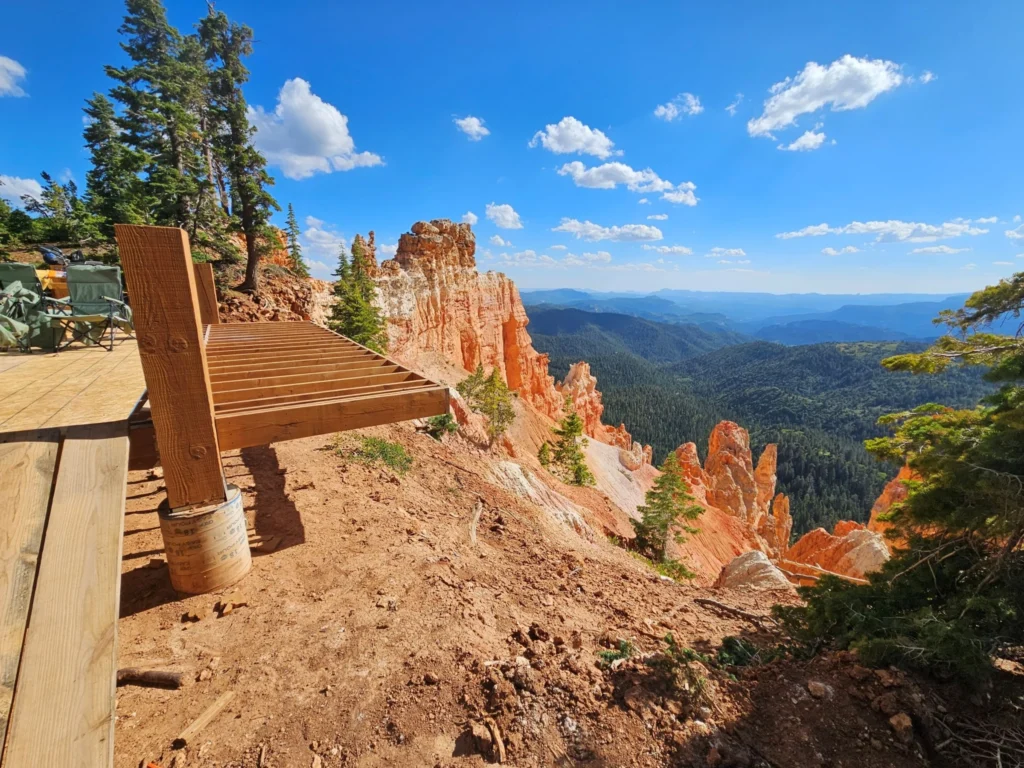
In Utah, our slope issues are amplified by:
- Freeze/thaw cycles, especially on south facing slopes
- Expansive clays that seem to attract water
- Undocumented fill and colluvial soils
- Desert conditions including lack of foliage and sudden precipitation
Typically, the depth of a footing is governed by frost depths. In any condition, the surface soils are rarely considered virgin, and slopes present unknown depths of lose soils. A spot footing placed on a slope often ends up bearing on soil that looks solid but often won’t stand for long. The result isn’t immediate failure, it’s slow movement over years.
Equipment, Access, and Concrete on Sloped Sites
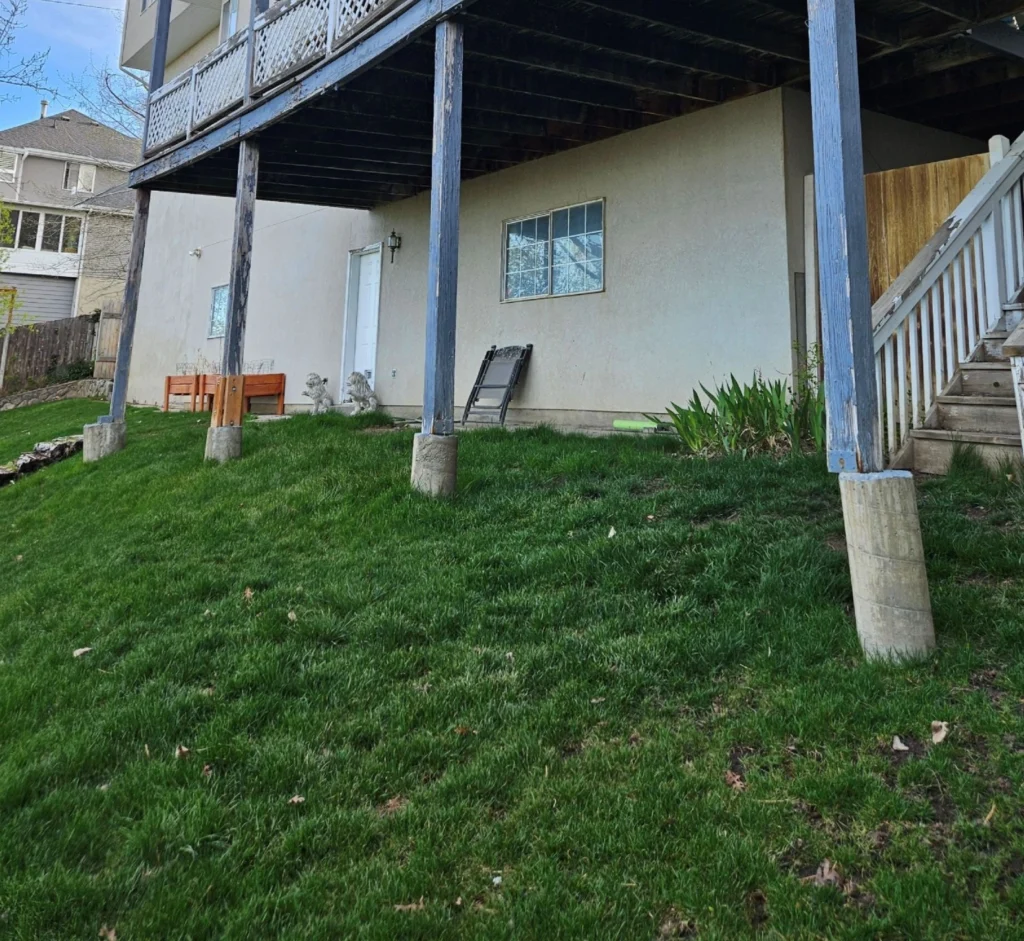
From our standpoint, as the builders, placing footings on slopes is rarely easy, efficient or safe. To name a few issues:
- Equipment – Due to equipment access limitations, footing excavation is often done by hand. More labor means higher costs and more incentives to shortcut the quality.
- Access – Getting equipment or materials to the location is almost always a challenge that most contractors will foresee, and ensure they are paid appropriately for the extra struggle and unforeseen issues.
- Forms – Forms have to be overbuilt to resist sloughing. If you look closely, most footings built on a slope are formed well, square and in the proper location. Form work is fighting the weight of the concrete; and in this case, also fighting the downhill slope from taking all that concrete out.
- Concrete – Once all the prep work is done, there is still the issue of pouring the concrete. Structural concrete is not to be compromised with hand mixing onsite. Pumps, hose and other subs are required to bring cement from a parked mixing truck to the footing location.
Contractors have a few solutions during the construction of poured footings on a hillside:
- Over-excavation just to reach “acceptable” soil
- Larger footings to compensate for uncertainty
- Added concrete, rebar, and labor with no real gain in performance
The costs add up, giving clear explanation of why quality contractors will shy away from hill side footings if not increase their prices significantly to ensure they can remain profitable while keeping a good customer.
The Shortened Lifespan of Spot Footings on Slopes
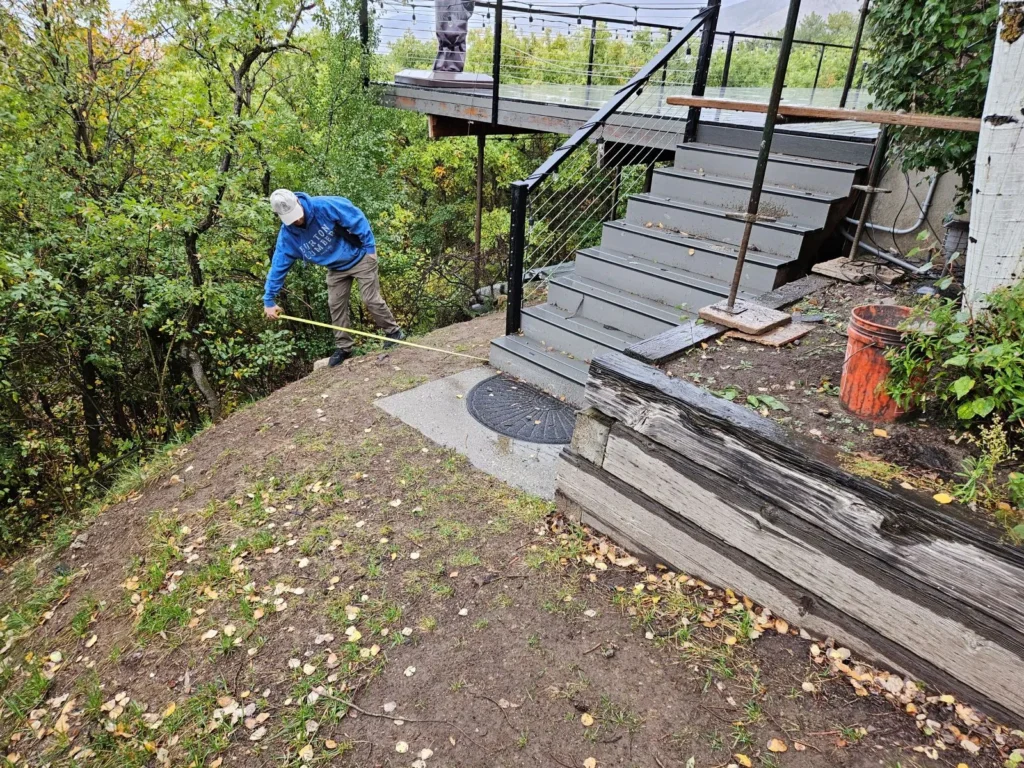
A poured footing on flat, undisturbed native soil by a quality contractor can perform well for decades. When building a footing on a slope, the lifespan is typically shorter. This isn’t because the concrete fails, but because the soil beneath the concrete changes.
Over time, downhill creep causes:
- Footings to rotate out of plumb
- Posts and columns to slide out of position
- Footings begin to pull at the structure, causing sinking and added weight to the other footings
These failures can be anywhere from slow to dramatic, but they’re persistent due to the nature of the shifting earth of any given slope. Once a spot footing moves, the repair options aren’t plentiful, and often a complete replacement is the only option.
Placing Footings on Slopes Without Relying on Surface Soils
A sure-fire method for a footing on a slope that won’t move, is increasing the depth of the footing into solid load-bearing soils. The organic surface soils of a slope should always be considered unusable, but to what depth? If digging by hand, you often limit your hole depth to 5 ft without significant excavation efforts.
Helical piers are installed by advancing steel shafts with helical plates down to competent bearing strata; thus bypassing the unusable soils. The helical piles are installed plumb, load-verified through torque monitoring, and irrelevant to the surface soils that make slopes unreliable.
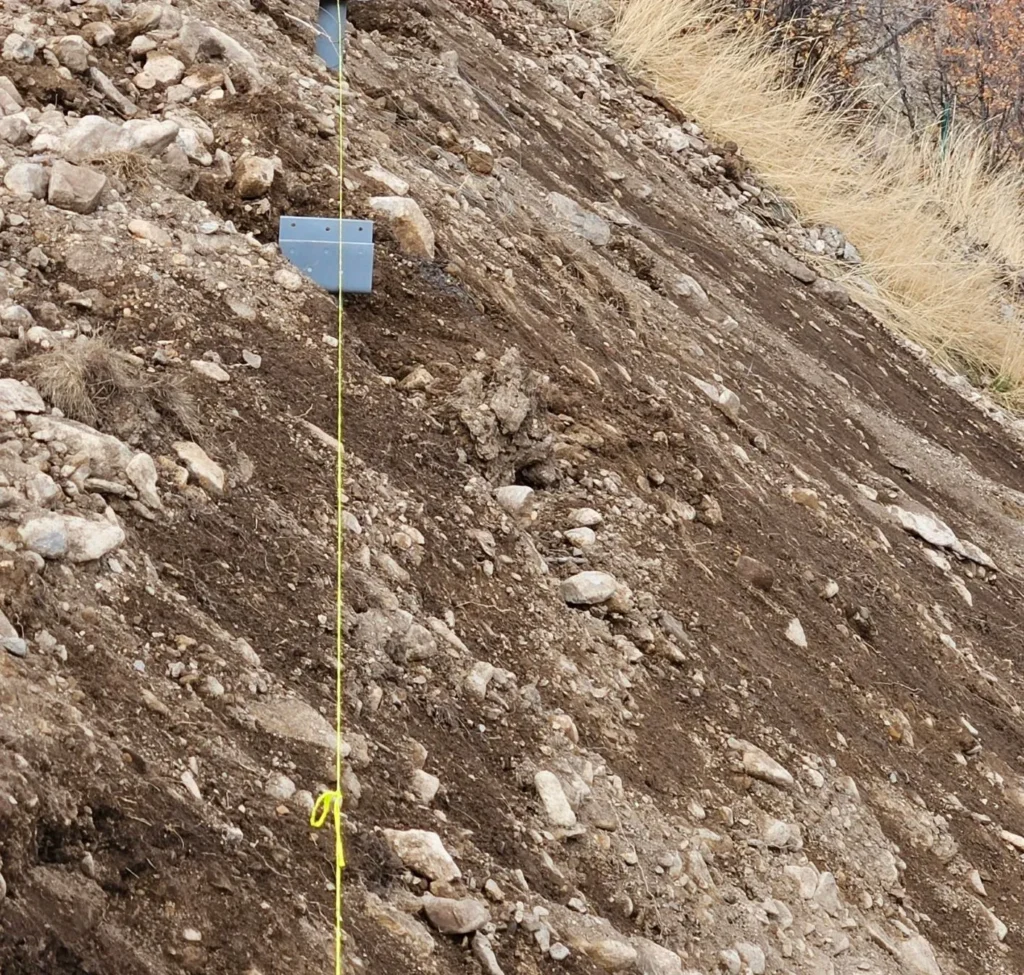
For our contractors, that means:
- No over-excavation effort is required
- Minimal disturbance to the slope
- The slope can still erode, shift and slide without affecting the thin pier shaft
- Load capacity is verified during installation
When placing footings on slopes with helical piers, the load is transferred below the active soil zone. This means a helical pier installed on a slope can perform in a manner that is identical to the performance of a helical pier or footing on flat soils.
Why Helical Piers Perform Better on Slopes in Utah
Utah soils vary dramatically from site to site, most geologists can concur. It seems neighboring lots all across the Wasatch Front have unique properties and considerations. You can’t throw a rock without it resting in a different geological feature. This variability is exactly why shallow footings struggle on slopes; helical piers:
- Extend below frost depth without excessive excavation or hardware
- Bypass expansive or loose surface soils
- Perform consistently across variable conditions
- Are easy to inspect and document for engineers and inspectors
Using the tested and proven methods of helical piers, from an American manufacturer offers benefits more than just quick and easy footing solutions
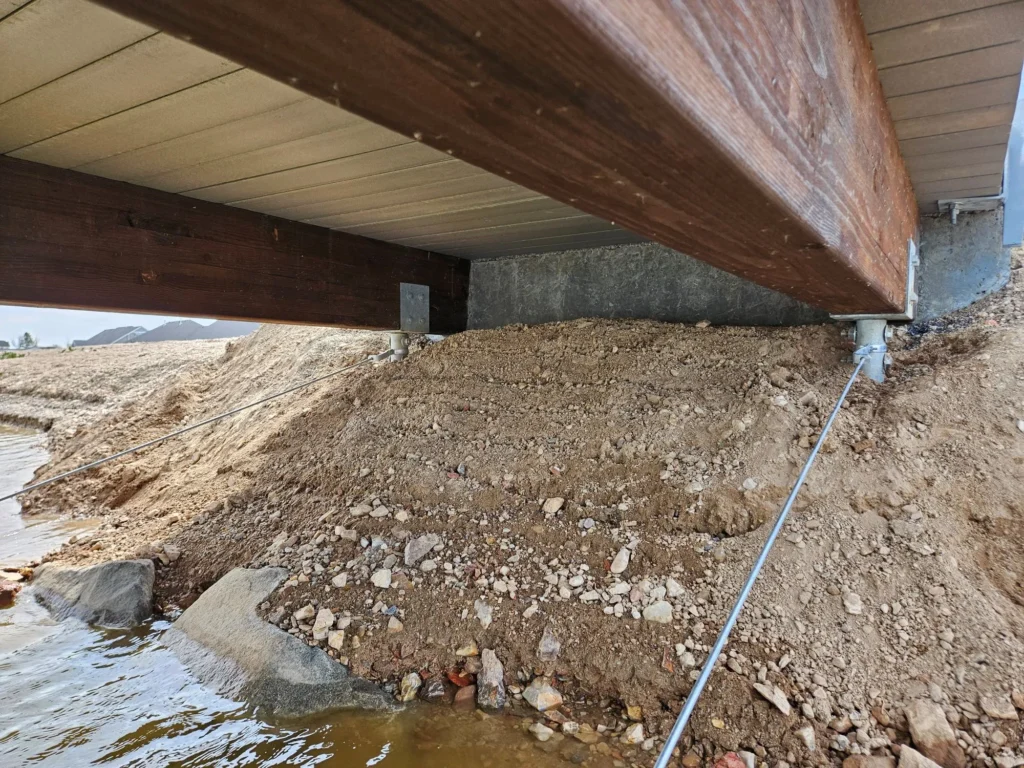
Real-World Applications We See Every Week
We regularly install helical piers all over the Wasatch Front for:
- Decks stepping down steep backyards
- Home additions near hillside cuts
- Porch and awning columns on sloped lots
- Retaining-adjacent foundations where soil is compromised
In many cases, the cost difference between a poured footing and a helical pier is negligible, and even cheaper due to a cost savings of added concrete, rebar, labor and forms for complicated slope footings. When considering the compromises available, helical piers shine for verifiable loads in almost any soil condition.
A Practical Takeaway When Placing Footings on Slopes
Now that you know a little more than before, placing footings on slopes doesn’t have to be a risk you accept. Slopes don’t become stable just because concrete is added, they require foundations that are independent of surface soil behavior. Every site is different. Soil conditions, slope angle, loading, and access all matter.
Helical piers provide that piece of mind to help you sleep at night. They install cleanly, predictably, and without relying on more concrete or over-excavation to solve a soil problem that nature always wins. This is why we approach each project as a problem to solve rather than a sale to close.
At Utah Screw Pile & Helical Pier, we help build quality solutions regularly across Utah and southern Idaho. If your project involves a slope, a tight site, or a foundation detail that doesn’t feel just right, we’re happy to review it with you.
Please contact us or give us a call to discuss your project, we can’t wait to meet you.