If you’ve ever wondered when helical piers are needed in construction, the answer often starts beneath your feet. Utah’s soils can range from dense gravel in Ogden to soft clay and loam in Saratoga Springs or Draper. While traditional concrete footings work well in stable soil, helical piers provide a proven advantage when conditions are less than ideal.
As Utah’s trusted foundation specialists, Utah Screw Pile and Helical Pier installs helical piers for both new construction and foundation repair projects across the Wasatch Front. Understanding when they’re needed can save builders and homeowners time, money, and long-term headaches.
When Helical Piers Are Needed: Poor Soil, Frost, and Shortened Timelines
In some Utah communities, home sites can be built on collapsible or expansive soils that shift with moisture and temparature changes. When that happens, concrete footings can settle unevenly, leading to cracked slabs and misaligned framing. Helical piers bypass these unstable layers entirely, transferring the structure’s load down to firm bearing strata or bedrock.
You’ll typically see helical piers specified when:
- Expansive clays are present
- Frost depth exceeds typical footing depth like in Heber City or Park City
- High water tables prevent clean excavation or cause footing failures.
- Remote or hillside sites make concrete delivery difficult.
- Cold weather demands a system that can be installed without curing concrete
Helical piers don’t require concrete curing time. They can be installed and verified in a single day, providing instant load-bearing capacity and don’t require expensive dewatering. Often, traditional footings can’t match this speed and convenience.
Replacing a Sonotube Footing with a Helical Pier
One of the most practical examples of when helical piers are needed is during the construction of small structures like decks, cabins additions, or porch posts. Many of these are supported by sonotube footings, often about 12″ in diameter.
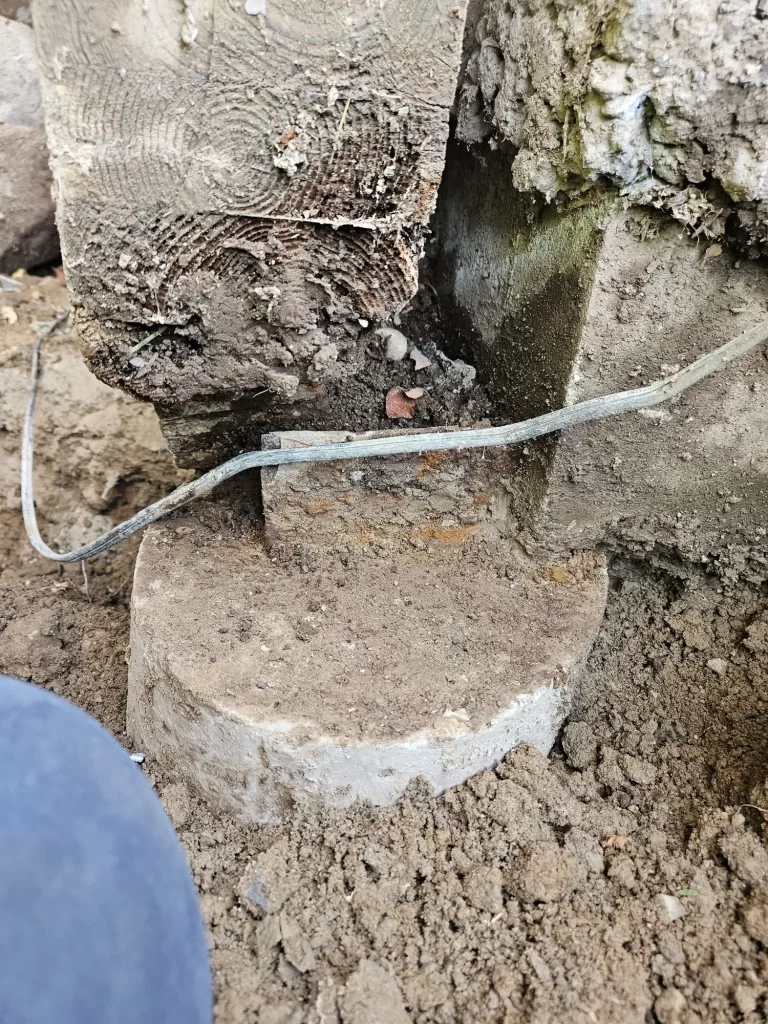
While sonotube style footings are cheap and familiar, they rely heavily on surface soil strength. If that soil is weak or wet, the footing can tilt or sink over time; especially if the concrete was installed incorrectly. In contrast, a helical pier is mechanically advanced deep below frost depth until it reaches stable soils. A bracket or plate is then attached to support the column or beam. Learn about our custom caps and brackets.
The result? No excavation delays, no waiting for concrete to cure, and immediate, verifiable load capacity using internationally accepted building code and robust ICC-ES evaluation. Along the Wasatch Front, more builders are switching to helical piers for this reason. They’re faster, cleaner, and far more reliable than hand-dug spot footings.
When Helical Piers May Not Be Needed
Not every project calls for a helical pier foundation. If your site has dense, well-drained soils with minimal frost risk, a traditional concrete footing can perform well at a lower cost.
Flat, compacted gravel pads or engineered fills often support standard footings just fine. Likewise, interior non-load-bearing walls within a slab-on-grade home don’t always require deep support unless there are known soil issues that have been brought up by the city or geotechnical engineer.
At Utah Screw Pile, we often recommend simple soil testing or a basic geotechnical review before construction begins. This helps determine whether a deep foundation system is warranted or if conventional methods are sufficient. You can learn more about Utah’s soil classifications and foundation design recommendations in the
Climate and Design can also Determine When Helical Piers are Needed
Utah’s climate brings extreme temperature swings, from freezing winters to hot, dry summers. These cycles cause frost heave and seasonal soil expansion, especially in clay-rich regions. Unlike shallow footings that move with the soil, helical piers are anchored well below the frost line, keeping structures stable year-round. Flood zones can also play a role in utilizing a deeper foundation, as per FEMAs recommendations.
Every pier’s capacity is verified during installation through torque measurement, ensuring engineering-grade reliability. This data-driven approach gives both homeowners and engineers confidence that the foundation will perform exactly as designed.
For more on how these systems work in Utah’s unique soils, visit our Helical Pier Installation Services page.
Environmental and Cost Benefits of Helical Piers
Helical piers minimize excavation, reduce concrete waste, and lower site disturbance. They can be installed in tight spaces, steep slopes, or existing landscapes without large equipment. While the cost per pier can be higher than a single footing, total project costs often balance out thanks to faster schedules, fewer inspections, and zero weather delays.
In addition, piers can be removed for future remodels with minimal disturbance. Thus, offering a flexibility that concrete foundations simply can’t match.
For examples of real projects where piers made the difference, explore our Foundation Repair and Underpinning services or read our Signs of Foundation Settlement.
Final Thoughts: Building Smart in Utah
Knowing when helical piers are needed comes down to one rule: build for the soil you have, not the soil you hope for. Utah’s terrain and weather can change from lot to lot, but with the right foundation choice, your project can last for generations.
If you’re planning new construction or noticing signs of movement in an existing structure, contact Utah Screw Pile today for a free foundation consultation. We’ll help you determine whether helical piers are the right solution—or confirm if your current design is already on solid ground.